Where the story came from
The dominance hierarchy as a concept entered animal behaviour through studies of captive chickens in the 1920s — the original "pecking order" — and spread quickly to other species, including horses. Much early equine research was conducted on fenced herds with artificial group compositions: animals thrown together as adults, in conditions that have no parallel in the wild. Priority at a hay net or water trough was read as rank. From those observations grew a model in which every horse occupies a fixed position in a linear hierarchy, with a dominant individual controlling the movements and resources of those below.
The model was simple, memorable, and easy to apply. It also flattened something genuinely complex into something misleadingly tidy.
What the evidence does and doesn't show
Observedwhat early captive studies proposed; every horse has a fixed rank position
when A beats B, B beats C, and C beats A, invalidating a clean linear order
using resource-holding as a proxy for rank; shown to be context-dependent
one animal causing another to move away; the most-recorded agonistic measure
a pair-by-pair social bond or pattern, not a group-wide structure
grooming, proximity, synchrony; underweighted by conflict-focused frameworks
What field studies actually show
Research on free-ranging horses — the feral bands of Camargue, Assateague and the American Great Basin studied over decades — reveals a social structure that barely resembles the stable linear hierarchy the story requires. Bands are small, long-lasting groups, typically a few mares and their offspring with one or more adult males. Within them, relationships are dyadic: A may consistently displace B at a water source, B consistently displaces C, and yet C displaces A. Triangles like this, called intransitivities, should be impossible in a true linear hierarchy. They turn up frequently.
Priority of access to resources — the most common proxy for rank — also shifts with context. A mare who moves others away from a mineral lick may not be the same individual who initiates group movement to water. Initiation of movement, it turns out, is often disproportionately performed by animals who show no particular priority at feeding sites. The horse that "leads" by going first is frequently not the animal with the highest displacement score — a point that who moves first explores in detail. Leadership and dominance, if they exist at all in horses, appear to be largely separate phenomena.
Consistency across time adds another complication. Relationships that look stable over a short observation window can shift substantially when a group's composition changes, when mares come into oestrus, or simply across seasons. Rank, to the extent it exists, is not a fixed property of an individual.
Leadership and dominance, if they exist at all in horses, appear to be largely separate phenomena.
The import problem
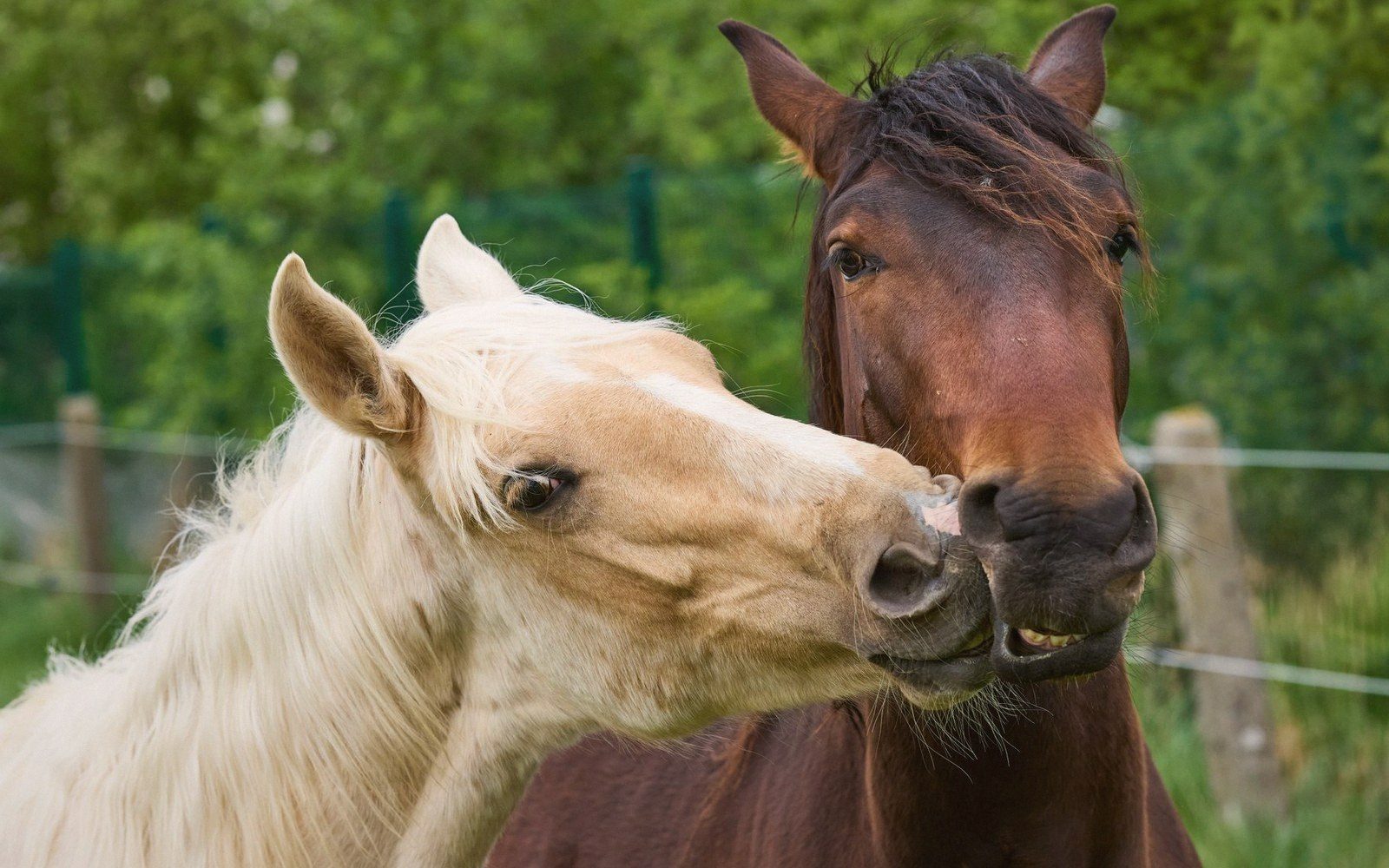
Part of the difficulty is methodological. Dominance is inferred from agonistic interactions — threats, displacements, bites — which are, in healthy free-ranging bands, relatively rare. Much of equine social life is affiliative: mutual grooming, proximity choice, synchronised movement. A framework built on who wins conflicts will systematically underweight a social fabric mostly held together by preference and tolerance.
There is also the transfer problem. The dominance concept was imported from wolves and primates, then revised for those species as better field data came in. The captive wolf studies that influenced so much popular animal behaviour writing have largely been superseded; wild wolf packs, it is now understood, are typically family groups in which the breeding pair's priority is a function of parenthood, not conquest. The revision has been slow to reach popular accounts of horse behaviour, where the original model persists with remarkable tenacity.
None of this means horses are indifferent to one another's presence or that social tension does not exist. Individual distance is a real and constant negotiation. Some animals consistently defer to others. Agonistic behaviour happens. What the evidence does not support is the idea that these interactions add up to a single, stable, linear order that organises the whole group's behaviour — or that any one horse is straightforwardly "in charge."
The persistence of the dominance story probably owes more to its explanatory convenience than to its empirical support. It gives observers a framework for every interaction they see: that horse is high-ranking, that one is low. The framework feels complete. The field data suggest it is, at best, a rough sketch of something considerably more interesting.