The geometry of a prey animal's eye
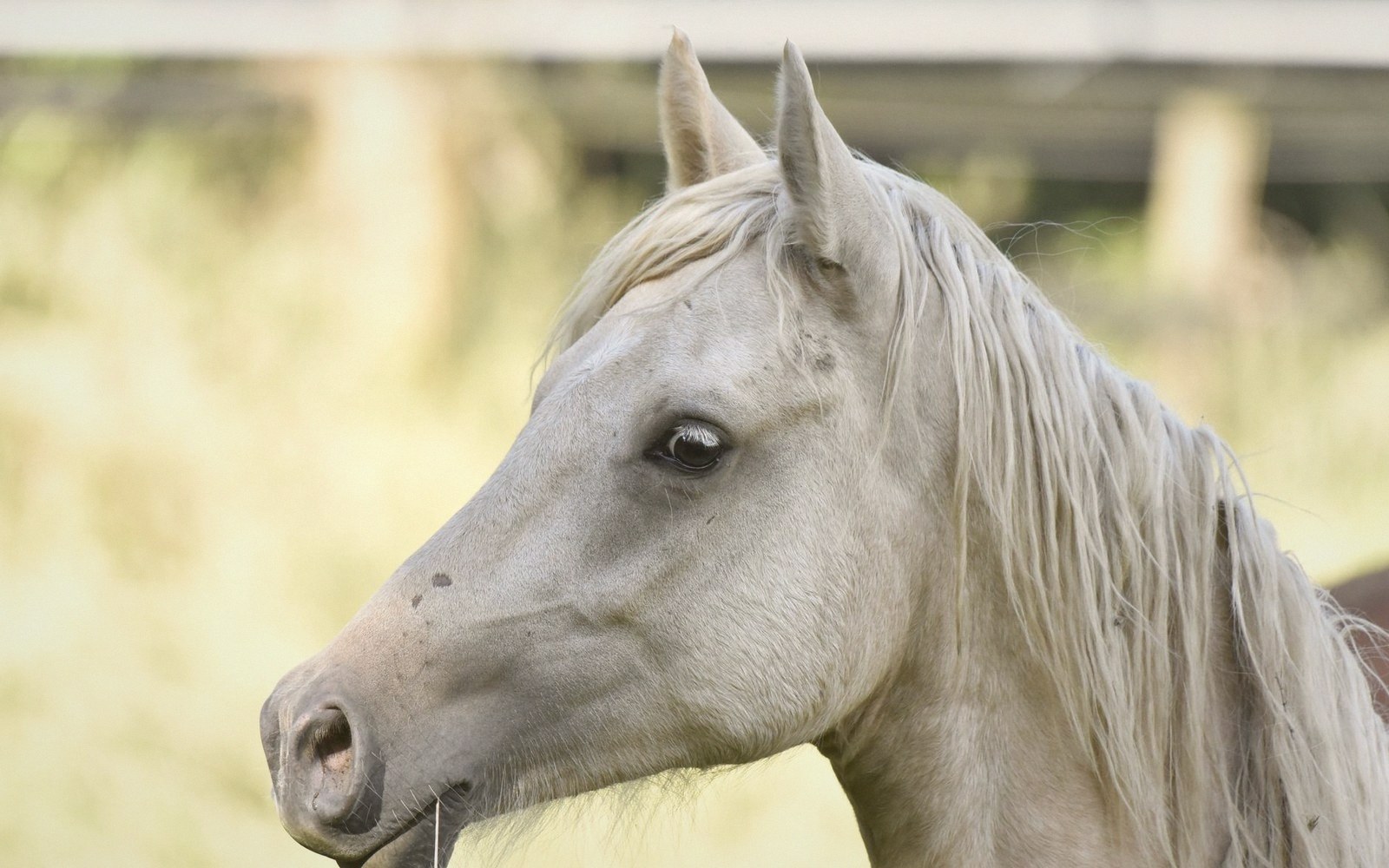
A horse's eyes sit on the sides of its skull, far back and high on the head, and that placement is not incidental. It is the defining fact of equine visual experience. Each eye sees a wide arc of the world independently, and together they give the horse a visual field that sweeps close to three hundred and fifty degrees around the body — a near-complete circle of awareness that no predator with forward-facing eyes could replicate.
Hold that picture: a horse standing quietly in a field is, from a perceptual point of view, watching almost the entire world simultaneously. The grass directly ahead, the treeline behind, movement in both flanks — all of it is present in the visual field at once. The system evolved for exactly this purpose. An animal that must detect the approach of a lion or a wolf benefits enormously from seeing the full circle, and a horse's skull geometry is the anatomy of that survival logic made bone.
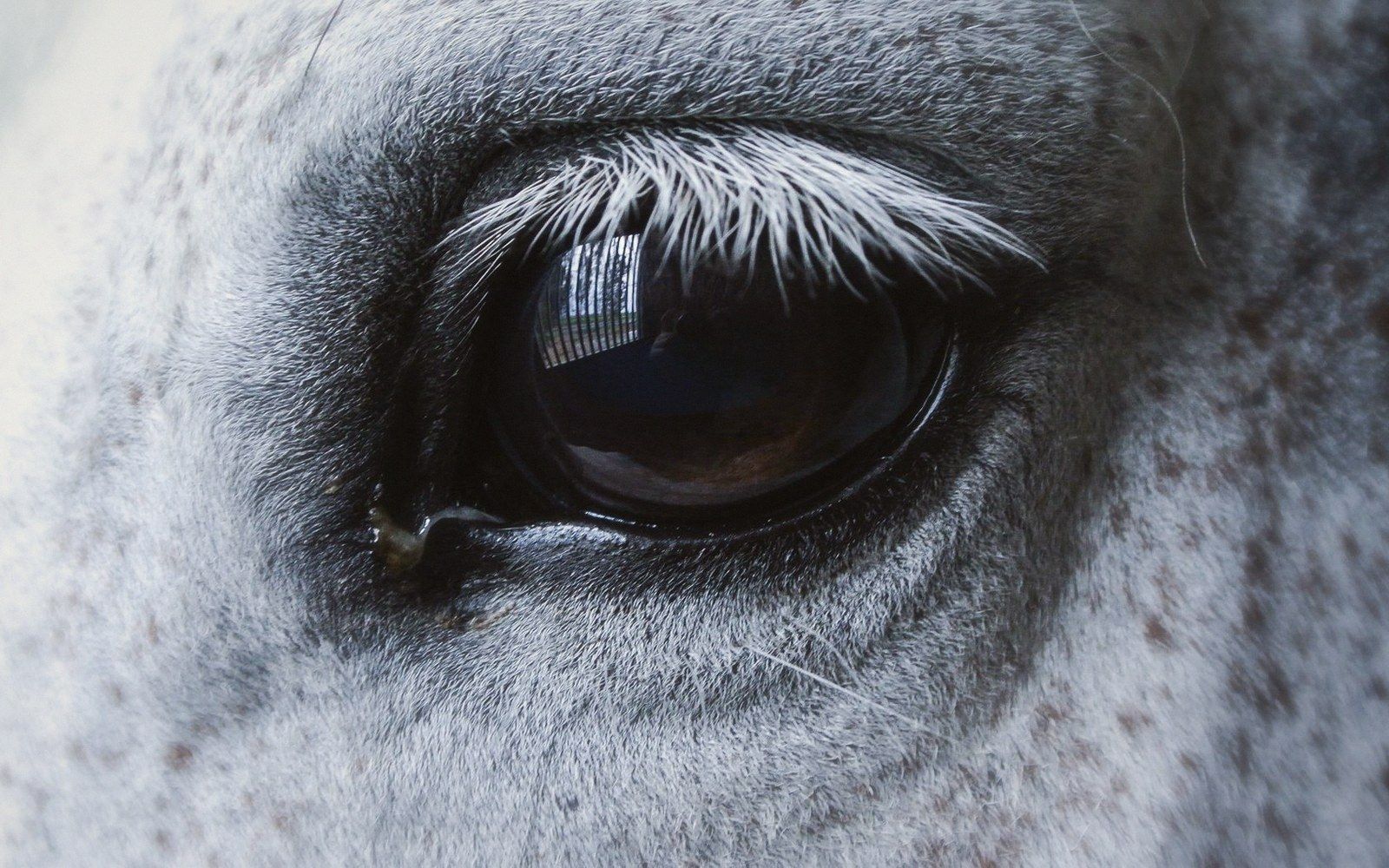
But a visual system this wide does not come free. Every arrangement of the eyes is a set of trade-offs, and the horse's arrangement trades depth and resolution across most of that panorama in exchange for coverage. Understanding what the horse gains — and what it gives up — explains a surprising amount of behaviour that people standing next to the animal routinely misread.
Wide view, narrow depth
The binocular field — the zone where both eyes look at the same point simultaneously and depth perception operates properly — is a narrow strip directly in front of the horse, estimated at roughly sixty to seventy degrees. In that corridor, the horse has good stereoscopic vision: it can judge distance with some accuracy, which is why a horse approaching a jump brings its head up or tips it slightly to line up the obstacle in that binocular band. Outside it, across almost the entire remaining sweep of the panorama, each eye is working alone. That monocular vision carries image information — movement, shape, contrast — but it carries almost no depth. The world to the horse's side is a wide, flat surveillance screen: it tells the animal something is there and whether it is moving; it tells very little about how far away it is or, critically, whether it is approaching.
This is the root of what gets called spookiness. A plastic bag moving at the edge of the visual field, sixty degrees off to the right, is registered clearly enough as something moving, but the depth information that would identify it as small and non-threatening is simply not available from a monocular image. The horse's brain receives a motion signal without an accompanying distance signal. Given that the evolutionary context for such signals has been, for millions of years, something is coming, the startle response that follows is not stupidity or bad temperament. It is the correct output from a correctly-functioning system. The system was built to react first and appraise later.
There are two blind spots in the panorama. The area directly behind the hindquarters — a narrow zone on the midline — falls between the two eyes' fields and is genuinely unseen. The other is directly in front of and below the muzzle: the animal cannot see what is immediately under its nose without tipping or turning the head, which is exactly what horses do when investigating something at close range. These are not quirks; they are architectural consequences of where the eyes sit. The panorama is extraordinary, but it has seams, and those seams are in predictable places.
The shape of the field
Observedestimated visual coverage of roughly 350 degrees
roughly 60–70 degrees, centred forward and slightly downward
narrow zone directly behind the hindquarters, on the midline
directly below and in front of the muzzle
What the coverage costs at close range
There is a further consequence of the wide-set eye arrangement that matters enormously at short distances: what is visible changes as distance decreases. An object at the edge of the visual field at ten metres may pass entirely out of view as the horse approaches it — not because it moved, but because the geometry of the eye positions no longer captures it. Losing a near object in this way, without any movement involved, is a genuinely disorienting experience for a visual system tuned to motion as the primary alarm signal. Something that was there is suddenly absent. The brain, again correctly, flags this as worth attention.
Acuity — the sharpness with which detail is resolved — is also lower than in humans across most of the field, and it drops further in the peripheral zones. The horse is not reading fine detail out at the edge of its three-hundred-and-fifty-degree sweep; it is reading movement and contrast. A stone has been sitting by the gate for a year and the horse has passed it every day without incident. Someone turns it over, or puts a hi-vis jacket on it, and the horse reacts as if it has never seen it. In terms of the information its visual system was recording, it essentially hasn't. The detail that made it a stone rather than something else was never the point of the system, and the changed surface now reads as different enough to be novel.
That monocular vision carries image information — movement, shape, contrast — but it carries almost no depth.
Reading the head position
Because the binocular strip is in front and angled slightly downward, where the horse holds its head determines what it can see in depth. A horse with its head at a natural grazing height sees the ground ahead in binocular detail — exactly what is useful when navigating terrain. A horse with its head high and neck raised is tipping the binocular corridor upward and forward, toward a distant horizon, which is the posture of an animal scanning for threat at range. It is also sacrificing detailed ground-level vision to do it. Neither posture is right or wrong; they are adaptations for different informational tasks, and the animal shifts between them in response to what the environment seems to be asking.
The connection between head carriage and what the horse can see also means that the visual experience of an animal required to carry its head in a particular fixed position is genuinely different from one with postural freedom — less a matter of aesthetics than of basic perceptual access. The horse with a fixed, constrained head position is not seeing the same world.
Three hundred and fifty degrees of coverage is a remarkable thing, nearly unimaginable from inside a primate's narrow forward-facing experience. The trade-off is a world in which most of the available information is flat, edge-detected and motion-sensitive, where small changes in familiar objects register as potential novelty, and where something not moving at the edge of the field may as well not exist. That is not a failure of the visual system. It is a prey animal's visual system working exactly as it evolved to work.