The horse sees colour — just not the same palette you do
A human eye contains three types of cone photoreceptor, tuned to short, medium and long wavelengths — roughly blue, green and red. The horse has two. That single difference reshapes everything it sees in colour terms, placing horses in the same broad category as people with red-green colour blindness, though the parallel is imperfect and worth unpacking carefully.
The two cone types horses carry are sensitive to short wavelengths (blue-violet) and medium wavelengths (yellow-green). The long-wavelength channel — the one that separates red from green — is absent. What this means in practice is that reds, oranges and greens tend to collapse toward one another: a green paddock and a red jump pole are not readily distinguished by hue. They may differ in brightness, texture and context, but not in the colour signal that human vision would use to tell them apart.
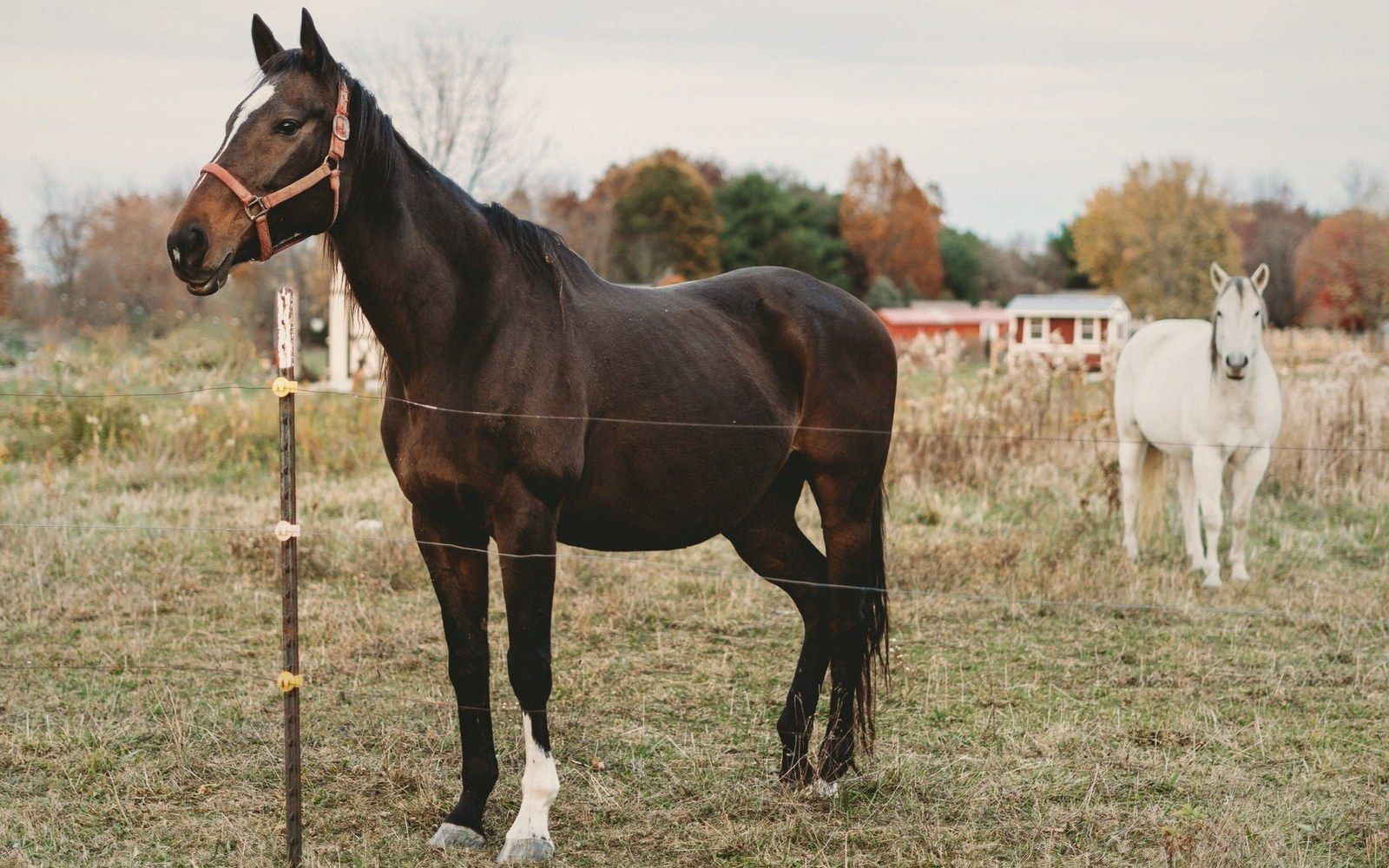
This is called dichromacy. Behavioural studies, including work using operant conditioning tasks that reward horses for choosing a specific hue, have tested horses on discrimination between colours across the visible spectrum. The results are consistent: blues and yellows are reliably distinguished; discriminating between red and green, or between green and grey, is either very poor or absent. Researchers differ somewhat on where exactly the boundaries fall, but the core finding has replicated across multiple studies.
Key distinction
Observedthree cone types; distinguishes red, green and blue independently
two cone types; blue-yellow axis intact, red-green axis largely absent
misleading term; dichromacy is a different palette, not an absent one
What the palette actually looks like
Dichromacy does not mean the world goes grey. A horse's visual world carries genuine colour — a blue sky is blue, a yellow patch of sunlight looks different from shadow, and the blue-violet end of the spectrum is well represented. What the horse loses, relative to a trichromat, is the red-green axis. The remaining colour information still distinguishes things. A bright red stable door and a plain wooden one probably look different in luminance and texture, and may appear distinct shades of what we might describe as yellowish or brownish, but not as red versus brown in the way a human would experience them.
There is also some evidence that horses may be sensitive to near-ultraviolet wavelengths that fall outside human vision entirely, because the equine lens transmits light at wavelengths that ours blocks. The functional significance of this is not yet well established — whether it produces meaningful perceptual experience or simply increases sensitivity at that end of the spectrum is still being studied. It complicates any simple claim that a horse's world is just a narrowed version of ours.
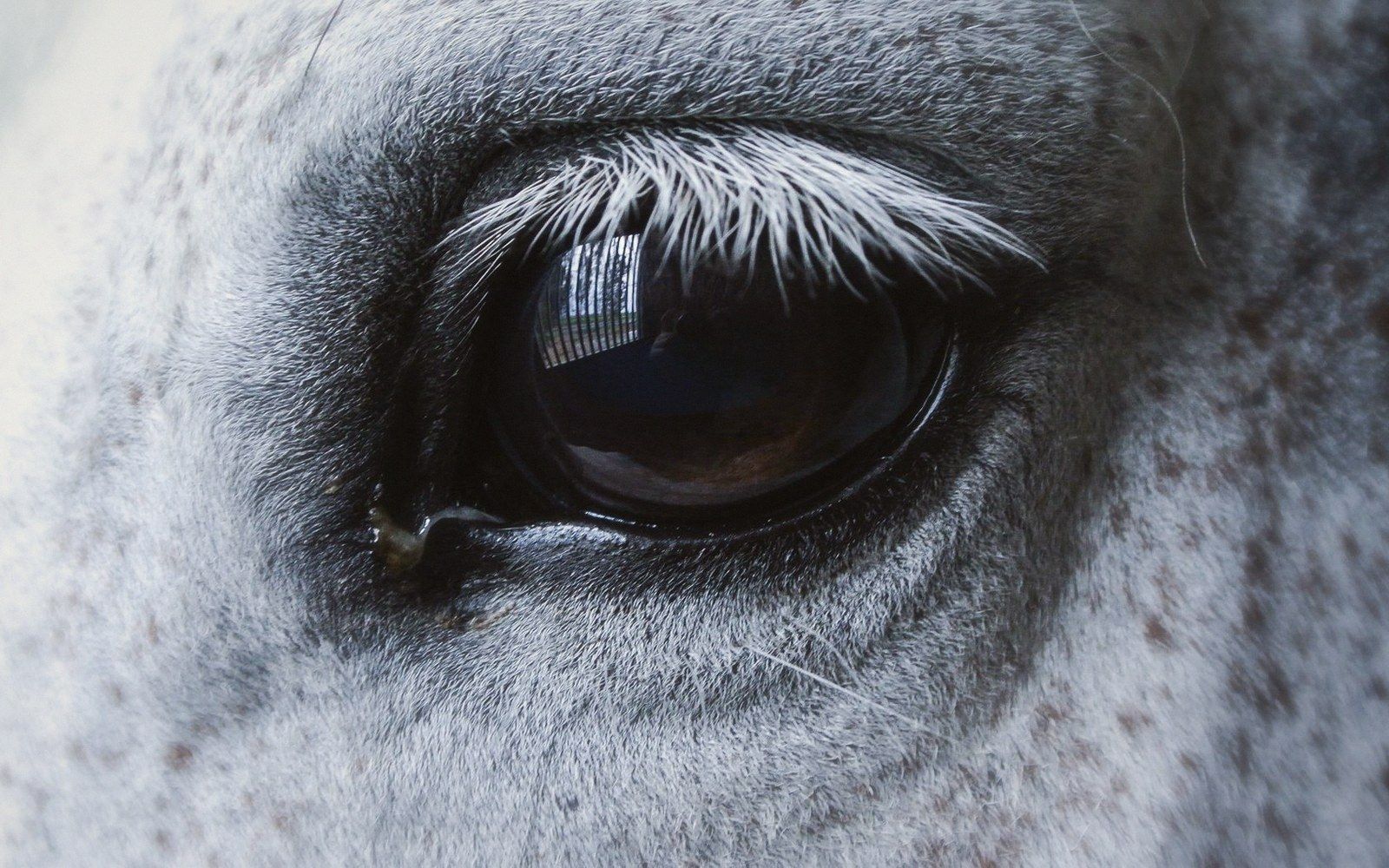
Acuity — the sharpness of detail within whatever the horse sees — is a separate matter from colour; the eye's spatial resolution affects how clearly the colour signal resolves across a scene. A horse has considerably lower visual acuity than a human observer, which means colours blend and smear at distances where we would still see sharp boundaries.
What the horse loses, relative to a trichromat, is the red-green axis.
Colour in context
The practical implications for how a horse perceives its environment are easy to overstate. Colour is only one of many sources of visual information. Luminance contrast, movement, shape, and texture all contribute, and horses are accomplished at using them. An object that provides no useful colour signal may still be salient because it moves, throws an unusual shadow, or sits in an unexpected location.
What the research does caution against is the assumption that the colours humans choose for equipment, fencing, or surroundings communicate the same information to a horse. A contrast that reads clearly to a human because it relies on red-green opposition may be nearly invisible to a horse. Blues and yellows are more likely to carry colour information across species; reds and greens much less so.
The horse is not colour-blind in the colloquial sense of the word — the term has always been a misnomer, even applied to people it describes. Dichromatic vision is a different relationship with colour, not an absent one. The palette is narrower and organised around different axes than human colour vision, but it is a palette. The horse sees colour. It simply does not see yours.